
How to Keep Your Kombucha SCOBY Healthy and Active
So you want to make kombucha yourself, but the idea of keeping a starter alive is daunting. Or the thought of ANOTHER thing to be responsible for is too much to handle. Don’t worry, brewing homemade kombucha is not like that!
Out of all the different probiotic and fermenting starters out there, I personally think keeping a kombucha SCOBY is the easiest. Between sourdough, kefir, yogurt, etc. Kombucha is by far the easiest.
I have been brewing kombucha and caring for a SCOBY for 8 years. In that time, I have also tried kefir and sourdough. If you can keep those alive, you can keep a kombucha SCOBY alive.
Proper Kombucha SCOBY care ensures consistent fermentation, better-tasting, and gut-healthy kombucha. This post is for kombucha brewing beginners or experts. Did you get a kombucha SCOBY and want to learn how to care for it? Do you have some issues with your SCOBY? This post is about how to care for your SCOBY. There will be a FAQ section at the end.
What is Kombucha?
Kombucha is a fermented sweet tea drink. It tastes like tart soda but with added health benefits of postbiotics that help your gut microbiome. Kombucha has gained popularity as a health drink because the fermentation process can infuse antioxidants and vitamins into the drink.
The flavor, sweetness, and bubbles of kombucha can be personalized to your specific preference. You need a SCOBY to brew your own kombucha. To learn more about kombucha and how to make it, check out this post
What is a SCOBY?
A SCOBY stands for Symbiotic Culture Of Bacteria and Yeast. Kombucha is a fermented sweet tea that needs a culture to kick-start the fermenting process. SCOBY are living microbes that grow with each batch of kombucha you make. This is the living community that actually ferments tea. They contain acetic acid, bacteria, and various yeasts, including Saccharomyces. The benefits of these microbes can improve gut digestion. The SCOBY lives in the liquid of your starter tea.
Some people name their SCOBYs to remember to feed and care for them. Mine is named SCOBY-Do.
What is the Pellicle?
Most people get the pellicle and SCOBY confused with each other. The pellicle is the off-white to light caramel colored, rubbery, pancake-looking layer that forms on top while brewing kombucha. Often referred to as a “new SCOBY” , it contains mostly cellulose, which is created by bacteria during fermentation. It is used as a protective layer that helps seal the brew and reduce oxygen exposure. The pellicle is not able to brew kombucha, although it can contain microbes. After brewing kombucha, you can reuse the pellicle, gift it to a friend, toss it, or compost it. People often get the SCOBY and pellicle confused because it’s visible and easy to hand off to someone new.
SCOBY = the microbes (mostly in the liquid)
Pellicle = the byproduct that forms on top
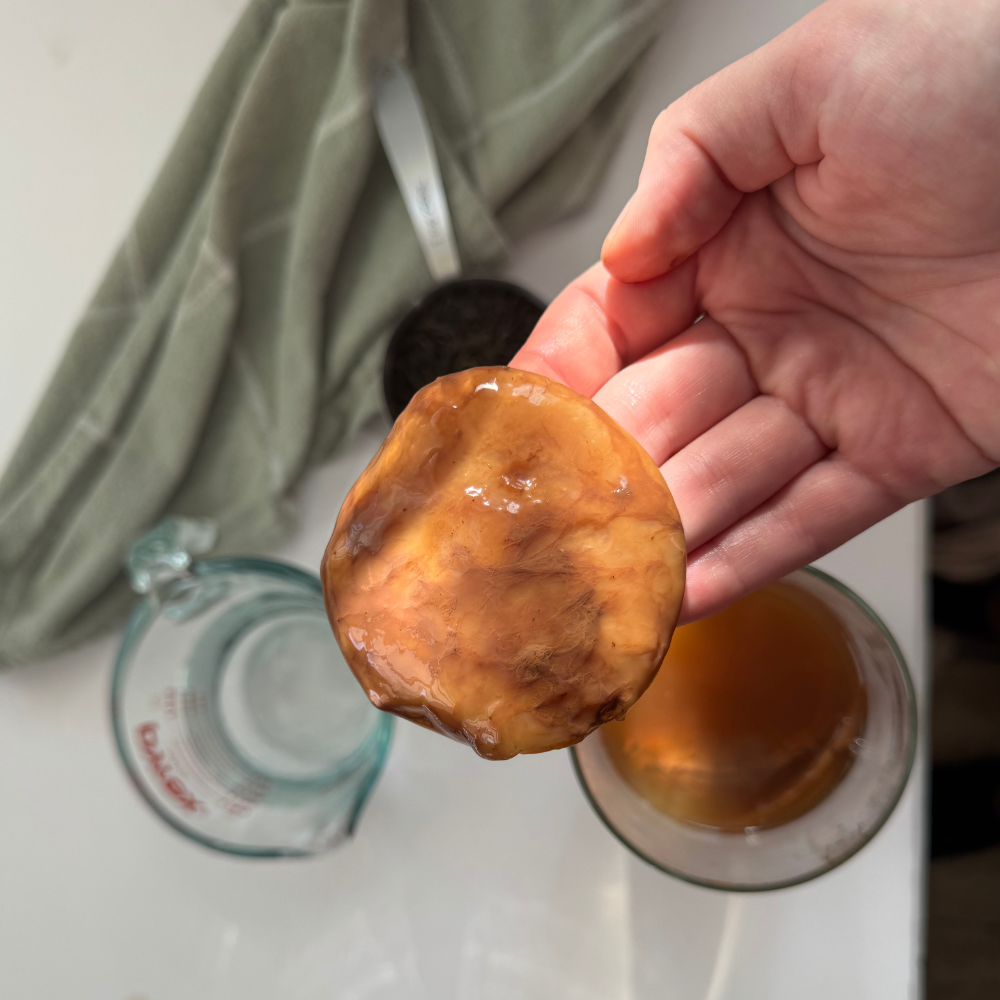
A Healthy Kombucha SCOBY
Show a SCOBY to someone who has never drank kombucha, and I bet you they will never want to drink kombucha. The strands, floating solids, and color are very turn-off-ish for beginners. All of those things are normal and signs of a healthy SCOBY! The dark brown strands are yeast strands. The floating solid part is the SCOBY. Don’t worry if your SCOBY floats to the top, sinks to the bottom, or hangs out in the middle- all are normal. The chunks at the bottom are yeast. All of the unsightly characteristics of the SCOBY contain the healthy microbes that ferment the kombucha and provide the gut health benefits. Plus, all of those bits are filtered out when it comes time to drink your kombucha.
SCOBY Care for Beginners
First, make sure your SCOBY will be in the ideal environment. SCOBYs should not be refrigerated; they should be kept at room temperature. The ideal temperature ranges from 65F to 85F. Make sure it stays out of direct sunlight. Don’t place your SCOBY near an air vent, because it will dry out the liquid faster. Store the SCOBY in a glass jar or container. Metal is not ideal for long-term use; short-term contact is ok. Kombucha is acidic and can leach properties out of the metal and into the kombucha. Don’t cover the jar that your SCOBY is in with an airtight lid. Cover the opening of the jar with a breathable material and fasten it to the jar with a rubber band. Securely fasten the breathable material to the jar. It lets the SCOBY breathe with air flow and keeps bacteria and bugs out.
How to feed a Kombucha SCOBY:
- Brew sweet tea – for 1 gallon jar: 8 black tea bags and 1 cup of sugar
- Then let tea cool to room temperature before pouring in with SCOBY – the boiling temperature will kill it
- Pour fresh sweet tea in a large glass jar with SCOBY and a cup of starter tea
- Cover it with fabric or a coffee filter
- Secure with a rubber band
To make the sweet tea, some people use green tea or flavored tea, black tea is recommended for basic brewing. I have made kombucha using hibiscus tea, and that turns the SCOBY a bright red. The SCOBY feeds off the sugar during both fermentations, so it is important to have the right type and quantity of sugar. White cane sugar is recommended. Sugar alternatives can represent different flavors, but should be used in the second fermentation process. For a 1-gallon jar: 8 black tea bags and 1 cup of sugar will be enough.
The more you brew kombucha, the more your SCOBY will grow. You grow a new pellicle with each batch. After repetitive brewing, refresh your SCOBY to expand its life span. Similarly to feeding it, take out some starter tea, and rotate or thin the SCOBY layers. Separating the SCOBY layers won’t damage it. You can use scissors to trim it or pull apart the different layers. Just make sure the scissors are clean.
Kombucha SCOBY Maintenance Tips:
- Feed regularly
- Store properly
- Rotate/ separate Layers
- Discard excess kombucha liquid
- Avoid contamination
What is a SCOBY hotel
A SCOBY hotel is the perfect way to store a kombucha SCOBY, especially for long-term use. It is an easy, low-effort way to keep a SCOBY healthy between batches. In my stage of life right now, I’m not able to brew kombucha as I used too, so I use a SCOBY hotel. I’ve had SCOBYs checked in there for the last 3 years while refreshing regularly.
How to create a SCOBY hotel
- Have a large glass jar
- Put multiple SCOBYs in the glass jar
- Put 1 cup of starter tea in the jar
- Add room-temperature sweet tea to the jar to cover the SCOBYs
- Cover with fabric and a rubber band
- Occasionally watch the liquid level so it doesn’t dry out
- Feed with fresh sweet tea every 3-4 weeks
How to Safely Handle and Store a Kombucha SCOBY
It is important to have clean hands and equipment when brewing kombucha or feeding your kombucha SCOBY. Any sort of bacteria introduced in the process could grow mold and kill your SCOBY. We can prevent this by cleaning our hands before handling the SCOBY. Make sure the containers and tools you use are cleaned.
Kombucha SCOBY Problems
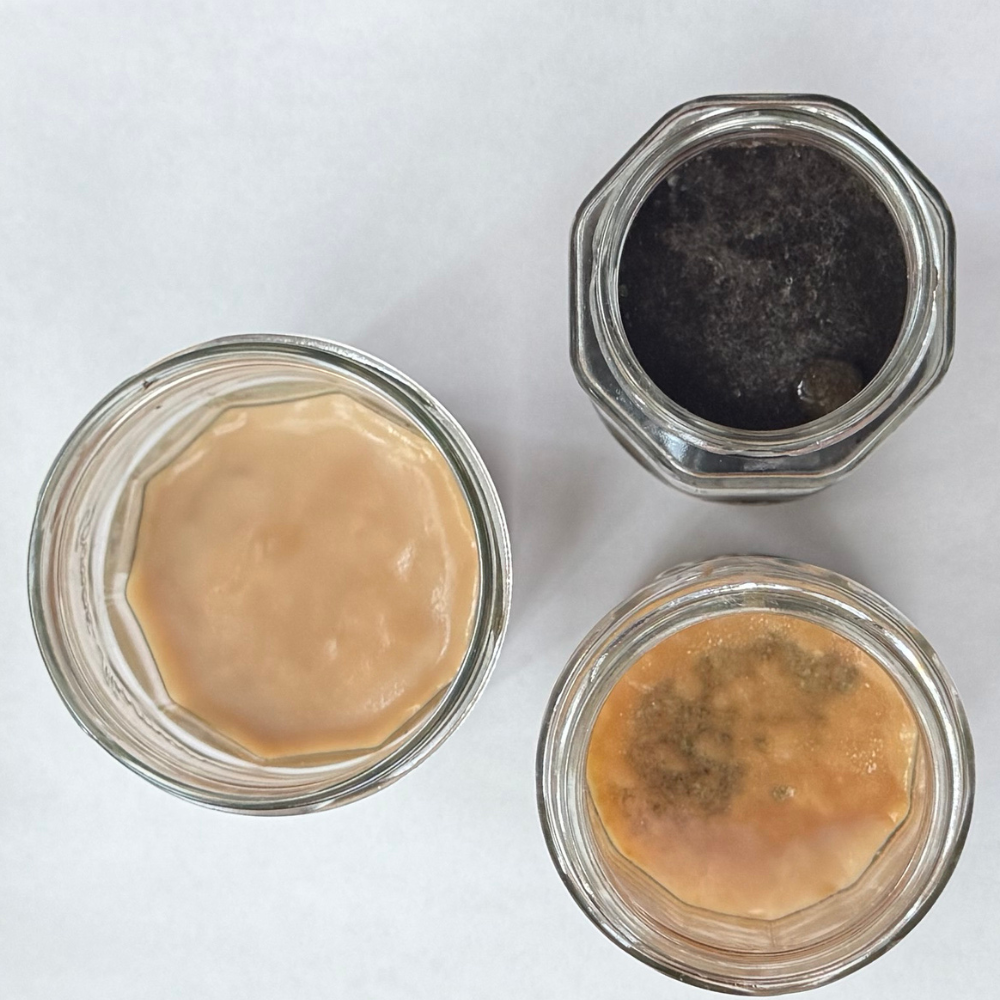
Mold
If you ever see fuzzy black, gray, blue, green or white spots forming on the top of the pellicle or on the jar- that is mold. If you have mold, you need to trash that entire batch. Mold spores spread throughout the liquid, and it will be unsafe to consume. Bottom of Form
Old
An old SCOBY is common when you brew kombucha for years without refreshing it. You can feed it SCOBYs no longer productive, or you will run into other issues.
Some signs you have an old SCOBY:
- Weak or slow fermentation (lasting longer than 14 days)
- No carbonation, tastes flat
- Strong vinegar smell
- No new growth on top (a pellicle)
- Extra dark brown color – excessive yeast
A Warning: Fruit flies
Fruit flies love kombucha. Please let this be a warning, because you know how impossible it is to get rid of fruit flies. If you do not cover your kombucha or SCOBY hotel, fruit flies will come. They will lay eggs in the jar. Gross. If you cover the jar after they lay eggs, you just trapped them inside with a food source to multiply like crazy. If that happens, the best advice is to restart. Fruit fly eggs can remain in the SCOBY or pellicle.
Be cautious about the fabric you use to cover your kombucha. If a little sweet tea spills on the fabric, fruit flies will flock to the fabric.
SCOBYs are hard to kill but they don’t last forever. You can replace your old one with a descendant of your original SCOBY – to keep the memory alive. Refreshing or starting over doesn’t mean you did anything wrong. You are just one person working with millions of microbes.
Frequently Asked Questions About SCOBY Care
Can a kombucha SCOBY die?
Yes, a SCOBY dies if it dries out or is exposed to mold. They are very resilient and can go weeks without being fed. In my experience, a partially dried-out SCOBY can be revived if fed with tea and sugar. Being stored properly can reduce the chance of mold growth.
What does a healthy kombucha SCOBY look like?
A healthy SCOBY is typically cream to light brown in color, rubbery or gelatinous in texture, and may have uneven layers. Brown stringy bits are normal yeast growth, not a sign of spoilage.
How do I know if my SCOBY has mold?
Mold appears as dry, fuzzy spots that are green, blue, black, or white and sit on top of the SCOBY. If you see mold, the entire batch should be discarded, including the SCOBY and liquid.
How often should I feed a kombucha SCOBY?
It depends if you are brewing to make kombucha or just storing in a SCOBY hotel. A SCOBY will be fed each time you brew kombucha, usually every 7–14 days. When stored in a SCOBY hotel, feeding every 4–6 weeks is sufficient, just make sure the liquid doesn’t dry up.
What happens if my SCOBY dries out?
In my experience, a partially dried-out SCOBY can be revived if fed with tea and sugar. People sell dried SCOBYs , and you have to rehydrate it to brew kombucha. I think you can give it the old college to try and try to revive it.
Can I store a SCOBY in the fridge?
Refrigeration is not ideal for SCOBY storage. Cold temperatures slow fermentation and can weaken the culture. Room temperature storage with sweet tea is best for long-term health.
How long does a kombucha SCOBY last?
With proper care, a SCOBY can last for many months or even years. Many brewers periodically rotate older SCOBYs out and use newer layers for brewing.
Why did my SCOBY sink or float?
SCOBYs can sink, float, or hang in the middle of the jar—this is completely normal. Fermentation will still occur as long as the liquid is healthy.
Can I use flavored tea to feed my SCOBY?
It’s best to use plain black or green tea. Flavored teas, herbal teas, or teas with oils can weaken or damage the SCOBY over time.
What should kombucha smell like during fermentation?
Kombucha should smell slightly sweet, tangy, or vinegary. A rotten or cheesy smell may indicate contamination.
Have another question? Leave a comment!
Conclusion
I love brewing kombucha because the flavoring opportunities are endless. If you want 15 different recipe ideas to start off your brewing journey, check out this blog post. Just remember to feed it with room-temperature sweet tea and cover your jar to keep those fruit flies away! SCOBYs are resilient, you got this!
Leave a comment with your SCOBY name! Mine is named SCOBY-Do
This post may contain affiliate links. Please read our disclosure policy





One Comment