
How to Buy a Pork Share (Half or Whole Pig) + FAQs
Buying a pork share is different than buying in bulk from the grocery store. It can be confusing for first-time customers and for farmers. Because what do you mean I am selling you a product that I don’t know how much it will cost or when it will be ready?? Yea, that’s kind of what a pork share is. My goal with this is to explain all the possible areas of confusion with pork shares so you can feel informed and excited about signing up.
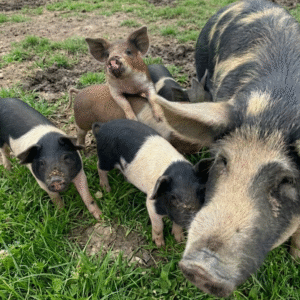
What Is a Pork Share?
A pork share is when you purchase a half or whole pig directly from a farmer, they raise it, and take it to the butcher for you for processing.
Pork shares are a cost-effective way of filling your freezer by buying in bulk and directly supporting the farmer. By purchasing a share, you are helping offset the cost of raising the pig. In return, you get the meat cuts selected to your preference. Think CSA (community support agriculture) for meat.
The difference between buying a share of meat and buying in bulk is that you don’t know the exact weight of the pig and the exact day you will get it. The farmer shares that variability with the consumer. Each pig grows differently, and they might not be “ready” at the same time.
Different farms offer different package options. The most common options are half or whole pig shares. I’ve seen breakfast and grilling packages available too. You can split the price with friends, coworkers, and family, depending on your needs. At the moment, we only offer half and whole shares. If there is enough interest, we might open up breakfast and grilling shares. Leave a comment if that is something you would be interested in.
It is industry standard to pay per pound by the hanging weight. You take home about 80% of the hanging weight. There are three different weights discussed in this process, so I will define each of them.
Live weight = The weight of the live animal on the farm
Hanging Weight = The weight after slaughter (blood/organs removed)
Packaged Weight = The amount of pork you will be receiving (can very based on bone in/out)
Why a Pork Share Instead of Individual Cuts?
Buying a pork share is the most affordable and direct way to purchase local meat. Individual cuts of pasture-raised pork can be more expensive due to the legal framework that prevents a farmer from selling directly to consumers.
This is a very in-depth conversation, especially in New Jersey, right now. There is simply not enough access for farmers and ranchers to take their livestock to be butchered and sold directly to consumers. Our friends at Mad Horse Meats are hoping to build a USDA-inspected processing facility on their farm. They explain why and their process here.
To try and summarize, almost all local butcher shops only sell pre-inspected meat that is not necessarily locally raised. For farmers and ranchers to be able to sell meat that they raise directly to the consumer, it needs to go to a USDA-inspected processing facility. The locations and availability of places like this are either privatized, have long wait lists, or geographically far.
However, there are more USDA-approved slaughter facilities. This is where an animal is humanely slaughtered and the carcass is prepared for further processing. We take our pigs to a USDA-approved and inspected slaughter facility. This means the meat is labeled “not for sale” and must be sold as a whole or half pork share directly to the customer. The meat isn’t any different from a USDA processing facility; the difference is that there isn’t an inspector on site at all times.
This is one reason why individual cuts can be more expensive. If you are looking for meat from a USDA processing facility, there are a handful of local farms that sell meat from them. They charge close to $10 a pound due to higher butcher and processing fees. We want to make pasture-raised pork affordable, and buying a pork share is often the most affordable and direct way to purchase local meat.
What Is Pasture-Raised Pork?
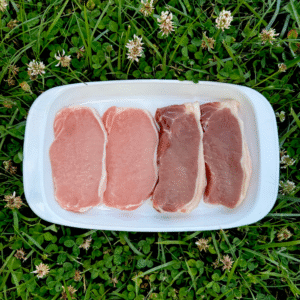
Pasture-raised pork comes from pigs raised outdoors on pasture, where they have access to sunshine, fresh air, and the ability to root and forage naturally in woodlands or open fields. This method of raising pigs develops a deep red color in the pork chop to the right. The pork chop to the left was bought from a grocery store.
As pigs search for bugs, grubs, roots, and legumes, they naturally till and fertilize the soil, improving soil health when farmers manage the land responsibly. Good pasture management includes rotating pigs to fresh pasture to prevent overgrazing and protect soil nutrients. However, not all pork labeled “pasture-raised” is raised this way. Some systems keep pigs outdoors on concrete pads, which prevents them from rooting and expressing natural behaviors that are important for their welfare and overall well-being.
To read more about the differences of pasture raised pork vs conventionally grown pork click here
What Comes in a Pork Share?
We currently offer half and whole shares. A half share will supply you with about 50-60 lbs. of pork. A whole share will supply you with about 100-120 lbs. of pork. You take home about 80% of the packaged pork from the total hanging weight. This is because bones are removed to make sausage, ground pork, etc. Our pigs will reach market weight in September or October of this year, 2026. The butcher takes about 3 to 4 weeks to process from drop off.
This is what I mean when I say I’m not sure how much it will cost you and when it will be ready. Each animal grows differently, and so there is variability with that. Even your take-home packaged meat from pigs with the same weight will be different depending on how you fill out your cut sheet. For example, bone in pork chops will weigh more vs. boneless pork chops.
A breakdown of cuts you can expect from a half and whole share are below
| Cut | Whole | Half |
| Smoked ham roast | 4 | 2 |
| Smoked ham steaks | 8 | 4 |
| Bacon (lbs.) | 14 | 7 |
| Scrapple (lbs.) | 16 | 8 |
| Boston butts | 4 | 2 |
| Picnic shoulders | 4 | 2 |
| Sirloin roasts | 2 | 1 |
| Rib roasts | 2 | 1 |
| Pork chops | 40 | 20 |
| Spare ribs (racks) | 2 | 1 |
| Sausage (lbs.) | 12 | 6 |
| Feet | 4 | 2 |
| Bones | 4 | 2 |
How the Process Works
- You pay your $50 deposit for either a half or whole pork share
- A sample cut sheet, cut guide, and Frequently Asked Questions guide will be sent to you upon deposit.
- If you have any questions, we will provide you with our contact information
- First 50% payment due July 1*
- Information about a “Meet your Meat” farm tour will be sent out for a July or August date
- Second 50% payment due August 30*
- You fill out the cut sheet and return it to us
- Pigs go to the butcher in September or October
- Pay the difference of hanging weight and the butcher fees*
- 4 weeks later, they are ready for your freezer! Either we will deliver it to you the same day or you can pick it up.
*For the 50% payments: we will base it on the low estimate of at least 50 lbs. for half share and 100lbs. for whole share. The butcher will tell us the hanging weight during the process, if it exceeds what has already been paid the difference (of 0-10 lbs.) will be owed. Vice versa, if the difference is below what has been paid, we will refund you. We do not anticipate it but I just want it to be communicated.
What We Charge
We charge $6 per lb. of hanging weight + butcher fees. Hanging weight is the weight of the pig after the internal organs are removed. You take home about 80% of the packaged pork from the total hanging weight. Pricing by hanging weight is the industry standard.
Butcher fees can range anywhere from $1 to $2 a pound and are paid directly to them. The price per pound can vary depending on how labor-intensive your cut sheet is. Things that can affect the butchering fees are the types of sausage you get, if you choose to vacuum seal each package, if you package by the pound, if you choose to smoke the meat.
A $50 deposit will hold your spot. 50% of the lower estimate of weight will be due July 1. The second 50% of the lower estimate of weight will be on August 30. The lower estimate of weight is 50 lbs. for a half share and 100 lbs. for a whole share.
When we take the pigs to the butcher, they will tell us the hanging weight, and if we aren’t perfect and don’t raise 50/ 100 lbs. of packaged pork, then the difference will be owed once the pigs are processed and ready for pick-up. We expect a variance of 0-10 lbs. from that 50 / 100lbs. If the difference is below what has been paid, we will refund you. We do not anticipate it, but I just want it to be communicated.
Why Choose Our Farm
We believe in transparency and building personal connections with our customers, which is why we offer opportunities like our “Meet Your Meat” farm tours so you can see firsthand how your food is raised. We raise pasture-raised heritage breed pigs with respect for both the animals and the land. Our pigs live outdoors on pasture with access to fresh air, sunshine, and the ability to root and forage naturally, which helps develop the rich flavor and quality that sets pasture-raised pork apart from conventional grocery store pork. Through regenerative farming practices and rotational grazing, our pigs naturally improve the soil while producing nutrient-dense meat for your family. By purchasing local pork shares, you can stock your freezer with high-quality meat while supporting local farming and keeping your dollars in the community.
To reserve a pork share from us, sign up today
Tips for First-Time Buyers
A pork share is an investment, so start small. If your family size is smaller, consider splitting with friends, family, or coworkers. Sign up for a half share and plan ahead for freezer space. A whole pig will require 6 cubic feet of space, and a half-pig share will need about 3 cubic feet.
Research or talk to your butcher about the cuts. Getting a share of the meat is the whole animal, so it is literally nose-to-tail eating. There might be new cuts of meat you aren’t familiar with. You can learn how to cook those cuts or just customize your cut sheet.
Ready to sign up? Reserve your share today!
Frequently Asked Questions
How much pork will I actually get?
- For a half share you can expect 50-60 lbs. of packaged pork. For a whole share you can expect 100-120 lbs. of packaged pork.
How long will it last in the freezer?
- 6–12 months (properly stored)
How Much Freezer Space Do You Need?
- A whole pig will require 6 cubic feet of space, and a half-pig share will need about 3 cubic feet.
What if I’ve never bought in bulk before?
- That’s ok! It is so satisfying, going to your freezer week after week to grab meat rather than relying on trips to the grocery store.
Can I choose my cuts?
- Yes, you will get a cut sheet to pick the quantities of cuts you want. For example: how many lbs. of sausage, ground pork, pork chops (bone-in or boneless) you get.
What is hanging weight?
- The hanging weight is the weight after slaughter with the blood and organs removed. This is about 60% of the live weight.
Is it more expensive than grocery store pork?
- No, pasture-raised pork can be up to $10 a pound. With pork shares, there is a higher upfront cost, but a lower cost per pound long-term.
When will my pork be ready?
- If you buy a pork share today (June 2026) they will be ready Fall 2026
What cuts do I get?
- A typical whole pork share includes approximately 4 smoked ham roasts, 8 smoked ham steaks, 14 pounds of bacon, 16 pounds of scrapple, 4 Boston butts, 4 picnic shoulders, 2 sirloin roasts, 2 rib roasts, 40 pork chops, 2 racks of spare ribs, 12 pounds of sausage, 4 feet, and 4 packages of bones. A half pork share includes half of those amounts: 2 smoked ham roasts, 4 smoked ham steaks, 7 pounds of bacon, 8 pounds of scrapple, 2 Boston butts, 2 picnic shoulders, 1 sirloin roast, 1 rib roast, 20 pork chops, 1 rack of spare ribs, 6 pounds of sausage, 2 feet, and 2 packages of bones.
Is your pork organic?
- We are not certified organic and will not seek out that certification because we want to hold ourselves to higher standards than just paying for a label. Our pigs are raised on pasture with room to roam. They do get minimal supplemental feed that consists of grain and corn, but this is very minimal in the grand scheme of their diet.
Is pasture-raised pork healthier?
- Yes! 8% higher protein, 2.4x more omega-3 fats, 60% lower omega-6: omega-3 fat ratio, 75% more selenium, 2x more vitamin E and 1,100 IUS of vitamin D
Does pasture-raised pork taste different?
- There is more flavor in the meat because the pig has foraging options while in pasture vs confined in conventional growing practices.
Are pork shares processed differently?
- Ours are labeled “Not for sale” because they are taken to a USDA-approved slaughter facility instead of a processing facility.
Are pasture-raised pigs fed soy or corn?
- Although their primary diet comes from bugs, grubs, legumes, berries, tubers, roots, and greens, they should still receive supplemental feed. This can vary based on the farmer or rancher. We feed a special pig specific grain and whole corn. The only way pigs could get away without having supplemental feed was if they were free range. Free range pigs are considered while hogs and extremely disruptive to natural ecosystems.
Can pigs really live outdoors year-round?
Yes our pigs live outside year round. In the summer they always have a puddle to cool off in. Pigs can’t sweat so they need a puddle to cool down. In the winter they have enough body fat to keep them warm. They also have access to a dry, draft free shelter year round.
This post may contain affiliate links. Please read our disclosure policy

One Comment